
Bitcoin Halving Cycles: What History Tells Us About the Next Bull Run
What Past Halving Cycles Reveal About Bitcoin’s 2025 Market Outlook

Bitcoin’s halving events have become one of the most anticipated phenomena in cryptocurrency markets, serving as reliable predictors of major bull runs throughout the digital asset’s history. As we stand approximately 180 days past the fourth halving in April 2024, understanding the patterns from previous cycles offers crucial insights into what investors might expect in the coming months.
The Mechanics Behind Bitcoin Halving
Bitcoin halving represents a fundamental monetary policy embedded directly into the cryptocurrency’s code. Occurring approximately every four years—or every 210,000 blocks—these events cut the mining reward in half, systematically reducing the rate at which new Bitcoin enters circulation. The first halving on November 28, 2012, reduced block rewards from 50 BTC to 25 BTC, followed by subsequent halvings in July 2016 (12.5 BTC), May 2020 (6.25 BTC), and most recently April 20, 2024 (3.125 BTC).
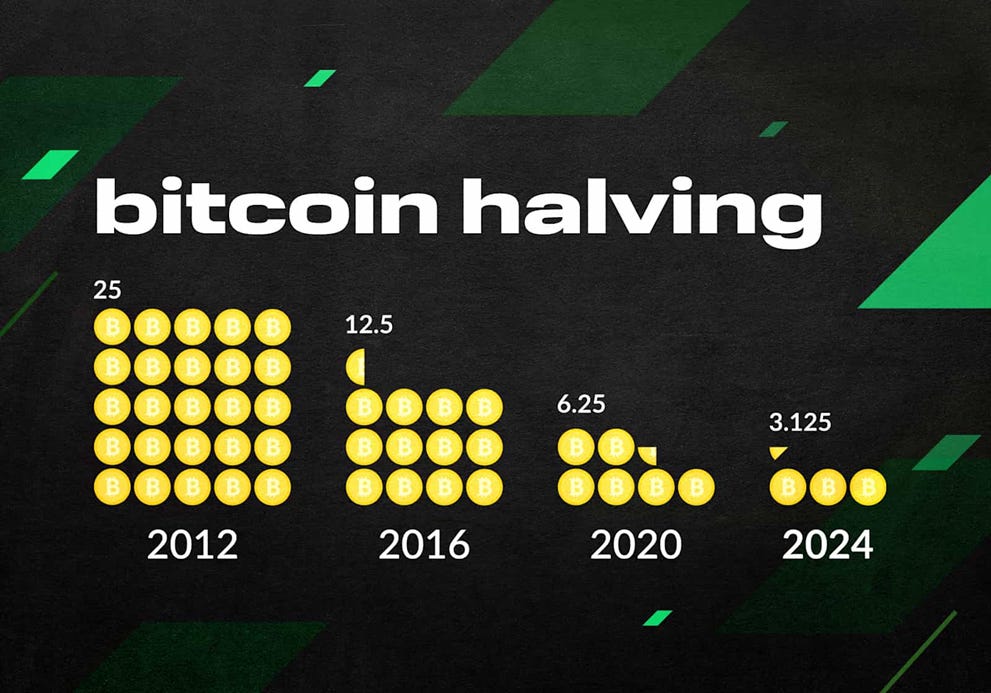
Visual representation of Bitcoin halving events in 2012, 2016, 2020, and the projected 2024 event, showing decreasing Bitcoin rewards over time.
This deflationary mechanism creates what economists term a “supply shock”—an abrupt reduction in available supply that, when combined with stable or increasing demand, drives prices significantly higher. Unlike traditional currencies where central banks can adjust monetary policy at will, Bitcoin’s halving schedule remains fixed and predictable, making it a unique case study in programmed scarcity.
Historical Performance: A Pattern of Diminishing Returns
Examining the three completed halving cycles reveals consistent patterns that challenge simple linear predictions. The first halving in 2012 triggered an extraordinary 9,308% price surge over 13 months, propelling Bitcoin from approximately $12 to $1,150 by November 2013. The second halving in 2016 produced a still-impressive but notably smaller 2,900% gain, reaching nearly $20,000 by December 2017 after 17 months. The third halving in May 2020 resulted in a 705% increase to $69,000 by November 2021, achieved over roughly 18 months.
This pattern of diminishing percentage returns reflects Bitcoin’s maturation from a speculative experiment into a multi-trillion-dollar asset class. As Bitcoin’s market capitalization grows, achieving the same percentage gains requires exponentially more capital inflow. However, the absolute dollar value of gains has actually increased with each cycle—a $12 investment at the 2012 halving became $1,150, while an $8,570 position at the 2020 halving reached $69,000.
Timing the Bull Market Peak
One of the most intriguing observations from historical data concerns the increasing time required to reach peak prices after each halving. The 2012 halving took approximately 367 days to reach its cycle top, while the 2016 halving extended to 526 days, and the 2020 halving required 547 days before topping out. This lengthening pattern suggests that Bitcoin’s bull runs are becoming more sustained and less explosive, possibly reflecting increased institutional participation and reduced retail speculation.[14][13][15][16]
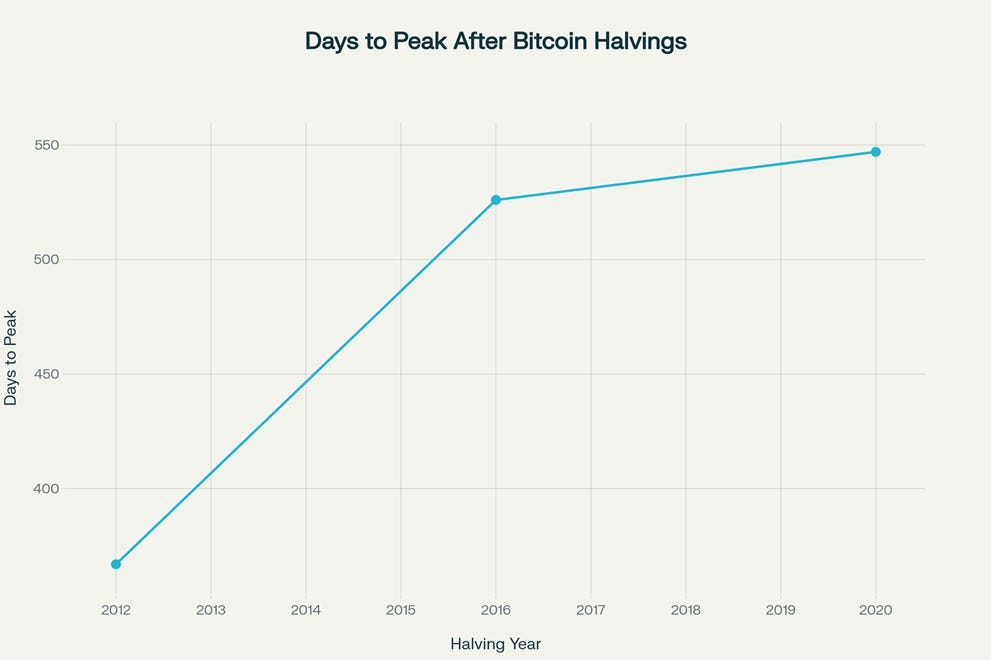
The time it takes for Bitcoin to reach peak prices after halving events has been gradually increasing, from 367 days in 2012 to 547 days in 2020.
Current cycle analysis places Bitcoin at approximately 523-550 days post-halving as of October 2025, positioning the market squarely within the historical “peak window” of 518-580 days that has characterized previous cycle tops. This timing has led prominent analysts to project potential peaks between October 2025 and early 2026, with price targets ranging from $150,000 to $200,000 based on the diminishing returns framework.
The Supply Shock Phenomenon
The post-halving supply shock operates on straightforward economics: when the daily issuance of new Bitcoin drops from 900 BTC to 450 BTC—as occurred in April 2024—miners have less supply to sell into markets to cover operational costs. This reduction happens instantaneously at the halving block, but its effects ripple through markets over subsequent months as existing supply gets absorbed.
Jesse Myers, co-founder of Onramp Bitcoin, emphasizes that this supply dynamic, rather than political developments or short-term catalysts, drives the fundamental price action following halvings. The mechanism creates a predictable scarcity that enhances Bitcoin’s appeal as “digital gold,” particularly as its supply inflation rate now sits below that of physical gold.
What Makes This Cycle Different
The 2024 halving cycle introduces unprecedented variables that distinguish it from previous iterations. Most significantly, the January 2024 approval of spot Bitcoin ETFs in the United States has channeled over $6.96 billion in institutional capital into cryptocurrency markets. BlackRock’s IBIT ETF alone attracted approximately $50 billion in assets under management within its first year, representing the most successful ETF launch in the company’s history.
This institutional infrastructure wasn’t present during earlier cycles. The 2012 and 2016 halvings occurred when Bitcoin remained largely the domain of retail speculators and technology enthusiasts. By 2020, institutional interest had begun emerging, but the scale pales in comparison to current adoption levels. Companies like MicroStrategy have accumulated 257,000 BTC during 2024 alone, while pharmaceutical and technology firms have allocated billions to cryptocurrency treasuries.
Additionally, the 2024 cycle witnessed Bitcoin reaching new all-time highs before the halving event—a historical first that some analysts suggest could indicate a “pre-halving rally” followed by extended consolidation rather than the traditional post-halving parabolic surge.
Navigating Uncertainty: Bull or Bear?
Not all market participants share optimistic projections. Some technical analysts applying Elliott Wave theory warn that the bull market may have concluded, projecting potential retracements to $70,000 or lower. These bearish scenarios point to concentration risk in ETF holdings, potential macroeconomic headwinds from a strengthening U.S. dollar, and the historical precedent that Bitcoin’s most explosive gains may be behind it.
The debate centers on whether traditional halving cycle metrics remain relevant in an era of institutional adoption and mature market infrastructure. Some analysts argue the four-year cycle has been disrupted, predicting either earlier exhaustion or extension into 2026 as institutional flows provide sustained demand beyond historical patterns.
Investment Implications
For investors attempting to navigate the current cycle, history provides a framework rather than a guarantee. The consistent pattern across three completed cycles shows bull markets developing 6-12 months post-halving and peaking around 500-550 days later. The diminishing returns phenomenon suggests realistic expectations for this cycle might center on 3-4x gains from the halving price of $64,000, implying potential peaks between $190,000-$250,000.
However, the unique institutional dynamics, regulatory clarity through ETF approvals, and broader macroeconomic conditions create variables that could accelerate, extend, or dampen historical patterns. The supply shock mechanism remains intact, but the demand side now includes corporate treasuries, pension funds, and sovereign wealth funds alongside retail investors.
Conclusion: Patterns, Not Prophecies
Bitcoin’s halving cycles have consistently preceded major bull runs, creating a compelling historical narrative of supply-driven price appreciation. The mathematical certainty of supply reduction combined with the psychological impact of scarcity has produced remarkably similar market patterns across three distinct cycles. Yet as Bitcoin evolves from a speculative asset into institutional infrastructure, the question remains whether future cycles will follow historical templates or forge new paths shaped by unprecedented levels of mainstream adoption.
As October 2025 unfolds with Bitcoin approximately 523 days past its latest halving, markets stand at a critical juncture where historical precedent suggests either an imminent peak or the beginning of a final parabolic phase. What remains certain is that the supply shock is real, the institutional interest is sustained, and the fundamental scarcity mechanism continues tightening with each passing block.
Sources:
1. https://www.kraken.com/learn/bitcoin-halving-history
2. https://cryptorank.io/news/feed/c02bc-bitcoin-bull-run-is-over
3. https://www.gemini.com/cryptopedia/bitcoin-halving-history-crypto-halving-dates-btc-halving
4. https://www.coinwarz.com/bitcoin-halving
5. https://www.binance.com/en/events/bitcoin-halving
6. https://www.binance.com/en/square/post/16147143296186
7. https://www.ledger.com/academy/glossary/supply-shock
8. https://www.osl.com/hk-en/academy/article/the-role-of-bitcoins-halving-in-bull-market-cycles
10. https://www.binance.com/en/square/post/19620093574041
11. https://bitcoincounterflow.com/charts/after-halving-comparison/
12. https://newhedge.io/bitcoin/price-performance-since-halving
13. https://www.cryptohopper.com/blog/crypto-bull-run-history-key-factors-that-drove-past-rallies-12260
14. https://www.binance.com/en-JP/square/post/7513309743169
15. https://www.bitcoinsuisse.com/learn/bitcoin-halving-market-cycle
16. https://www.binance.com/en/square/post/20029683547321
18. https://changelly.com/blog/bitcoin-price-prediction/
19. https://www.binance.com/en/square/post/18362680336169
20. https://www.ebc.com/forex/when-is-the-next-crypto-bull-run-2025-outlook-explained
21. https://www.reddit.com/r/Bitcoin/comments/1jitvpq/supply_halving_impacts_the_market_after_1218/
22. https://powerdrill.ai/blog/institutional-cryptocurrency-adoption
23. https://www.kucoin.com/learn/crypto/the-history-of-bitcoin-bull-runs-and-crypto-market-cycles
24. https://research.kaiko.com/insights/bitcoins-halving-anniversary-this-time-was-different
27. https://www.tokenmetrics.com/blog/next-crypto-bull-run
28. https://www.investopedia.com/articles/forex/121815/bitcoins-price-history.asp
29. https://charts.bitbo.io/price/
30. https://www.ey.com/en_ch/insights/blockchain/the-bitcoin-halving-explained
31. https://charts.bitbo.io/halving-dates/
32. https://kriptomat.io/finance-investing/the-bitcoin-halving-how-it-affects-crypto-prices/
33. https://www.investopedia.com/bitcoin-halving-4843769
36. https://charts.bitbo.io/halving-progress/
37. https://www.reddit.com/r/Bitcoin/comments/1ezpnml/how_many_of_you_truly_understand_the_driving/
38. https://kaironlabs.com/blog/crypto-bullruns-past-and-present
39. https://blog.bitpanda.com/en/the-ultimate-timeline-of-the-past-bitcoin-halvings
40. https://charts.bitbo.io/compare-bull-markets/
42. https://101blockchains.com/institutional-adoption-of-bitcoin/
43. https://www.statista.com/statistics/326707/bitcoin-price-index/
44. https://www.chainalysis.com/blog/north-america-crypto-adoption-2025/
45. https://coinledger.io/learn/bitcoin-halving-dates
46. https://arxiv.org/pdf/2501.09911.pdf
47. https://www.coinbase.com/price/bitcoin
48. https://finance.yahoo.com/news/bitcoin-price-could-collapse-70k-123918114.html
49. https://www.sciencedirect.com/science/article/pii/S106297692500047X
51. https://coincentral.com/btc-falls-hard-but-this-crypto-tops-best-altcoins-to-buy-in-2025/